The small words that decide a sale

Air360 Team on
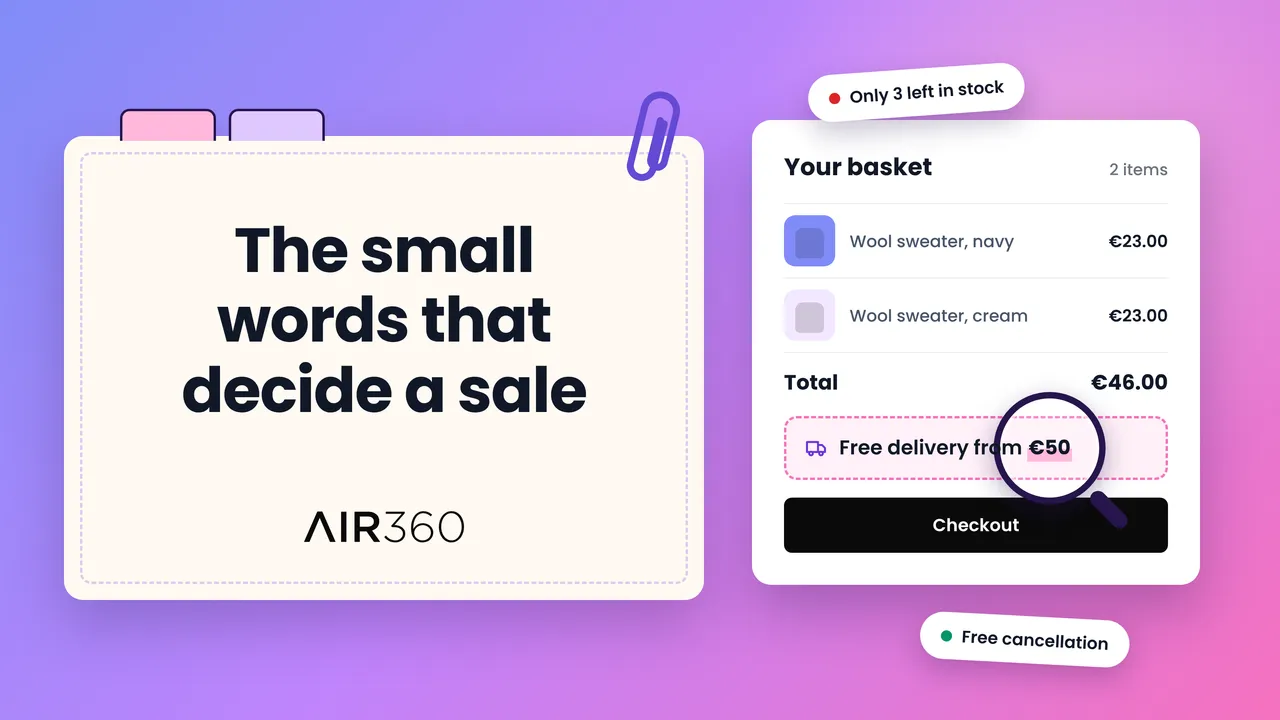
Picture a shopper on a Sunday evening. She has two sweaters in her basket for €46. Just above the button, a small line says “Free delivery from €50.” She stops, goes back to the shop, and adds a pair of socks.
Nobody on the marketing team will ever hear about that moment. But that one short sentence did more for the order than the homepage banner that took three weeks to design.
Every website is full of these little lines. They’re easy to write, easy to forget, and they often sit right where your customers make up their minds.
The quiet copy that carries your customer journey
Think about the short texts on your own site:
- “Free delivery from €50” in the basket
- “Only 3 left in stock” on a product page
- “Promo code applied” at checkout
- “Free cancellation until 48 hours before arrival” on a hotel booking page
- “No fees on your first transfer” on a bank’s sign-up form
None of them is a page. None of them is a button. So most analytics setups simply don’t see them. You can measure the page, the clicks on the big call to action and the conversion at the end, but the sentence in between stays invisible.
That’s a strange gap, because these lines answer the exact questions customers have just before they commit. How much will this really cost? Can I change my mind? Is this still available? When a customer can’t find the answer, or doesn’t believe it, they hesitate. And a hesitation on a checkout or booking page often turns into a closed tab.
Why these lines deserve your attention
Checkout research keeps pointing at the same thing. The Baymard Institute’s cart abandonment research has found, year after year, that unexpected extra costs such as shipping and fees are the top reason shoppers abandon their basket.
In other words, the words around price and delivery aren’t decoration. They’re where trust is won or lost. A delivery threshold that people see early can turn a surprise into a small goal. A reassurance line that nobody notices does nothing at all.
The same goes well beyond retail:
- Travel and hotels: “Free cancellation” and “Pay at the property” lines reassure people who are nervous about committing to dates.
- Airlines: baggage and fare-condition messages decide whether a customer trusts the final price.
- Banks and insurance: “No paperwork”, “Takes 5 minutes”, “Cancel anytime” lines make a long form feel doable.
Behind each of these lines is a real person, trying to decide whether you’re the right brand for them.
The questions worth asking about every important line
Instead of guessing, ask these four questions about the short texts that matter most on your site:
- Do people actually see it? A line placed below the fold on mobile might reach only a fraction of visitors.
- Do they interact with it? Clicks on a “Free returns” link or a “See conditions” text tell you people are looking for reassurance.
- What do they do next? Do the people who saw “Only 3 left” go on to buy more often, or do they leave?
- Does it differ by device or traffic source? A message that works on desktop can disappear on a small screen.
Here’s an illustrative example. An online shop notices that most mobile visitors never scroll far enough to see the free delivery message in the basket. The team moves it right under the basket total. Nothing else changes. Now they can follow how many people see it, and whether more baskets cross the threshold. The answer comes from their own customers, not from a best-practice list.
Turning words into answers
This is why we’ve just opened Text Events to every Air360 user. You can track any text on your site yourself, see how many visitors saw it and how many clicked it, and set up as many as you need without asking anyone. It works from the Air360 menu or right on your live page with the On-Page Analysis extension.
But the tool matters less than the habit. A few ideas to start this week:
- List your five most important lines. The ones about price, delivery, availability, cancellation and trust.
- Check where they sit on mobile. If people have to scroll to find them, many never will.
- Track them before you rewrite them. Know how many people see the current version, so you can tell whether the new one does better.
- Read them out loud as your customer. Is the answer to their worry clear in one go?
The brands that grow are rarely the ones with the most dashboards. They’re the ones who care about the small details their customers live with, and who check whether those details actually help.
Start with one sentence
You don’t need a big project. Pick one line your customers read just before they decide, and find out whether it’s doing its job. If you’d like to see how Air360 could help with that, pricing is a good place to start: see pricing →.
Related Posts

Digital experience analytics for e-commerce teams
Most e-commerce teams are drowning in data but still can't explain why users drop off. Digital experience analytics changes that, no data engineers required.

Conversion Rate Optimization(CRO) 101
Learn the fundamentals of conversion rate optimization (CRO), its advantages, and how it differs from other marketing techniques to increase revenue.

Effective Strategies to Boost Ecommerce Sales
Learn proven strategies to boost ecommerce sales, including website optimization, SEO, customer engagement, and exceptional service. Improve conversions and grow your online business effectively.